How to do it
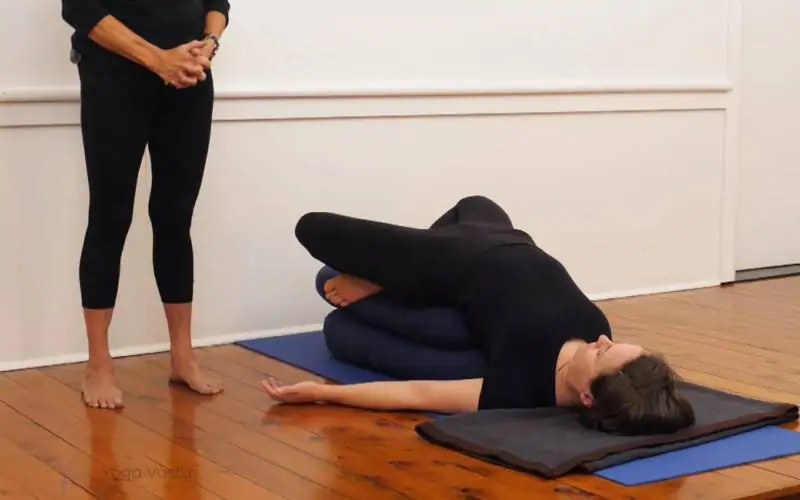
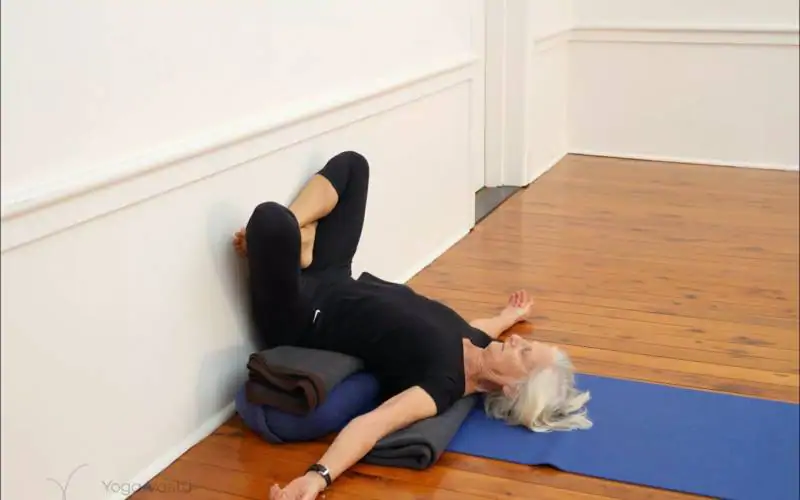
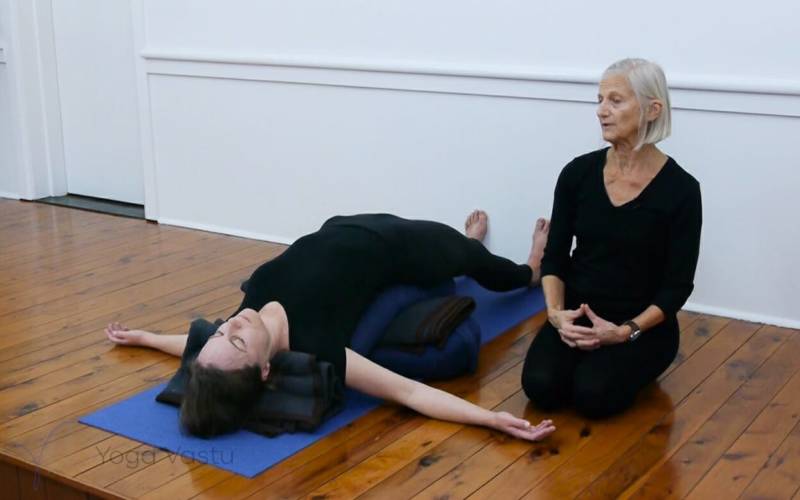
The standard Iyengar setup uses two bolsters laid end to end along the mat, or a padded bench, with the foot end near a wall. You also need a folded blanket for the floor and a belt.
- Lay two bolsters end to end along your mat, with one end about a leg’s length from the wall. Place a folded blanket on the floor at the other end, where your shoulders and head will rest.
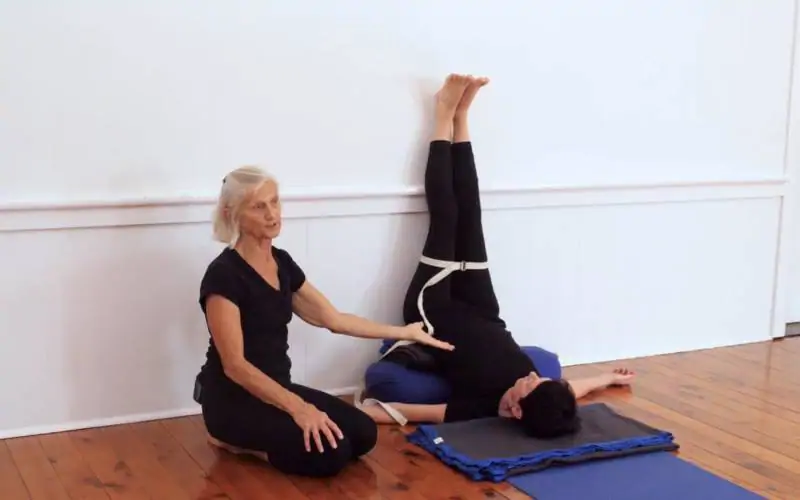
- Loop a belt around your thighs just above the knees, adjusted so the legs stay hip-width apart and do not roll out.
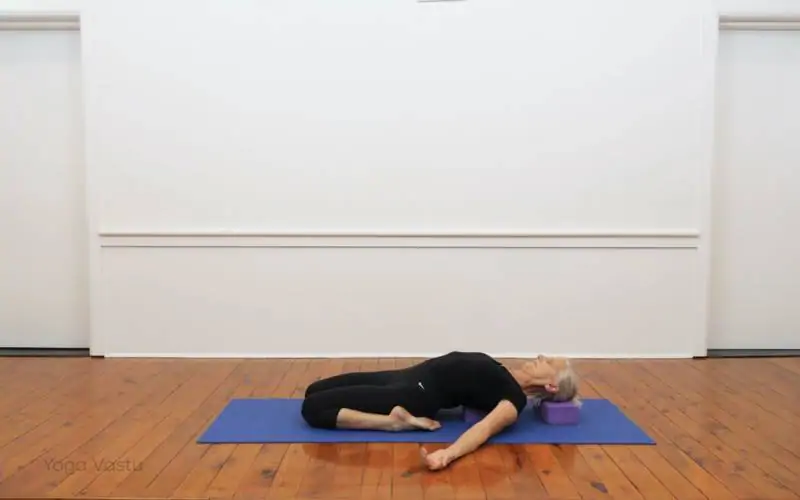
- Sit on the middle of the bolsters, facing the wall. Lie back and slide yourself towards the head end until the tops of your shoulders and the back of your head rest on the blanket on the floor. The edge of the bolster should sit under the lower shoulder blades, with the back, pelvis and legs on the bolsters.
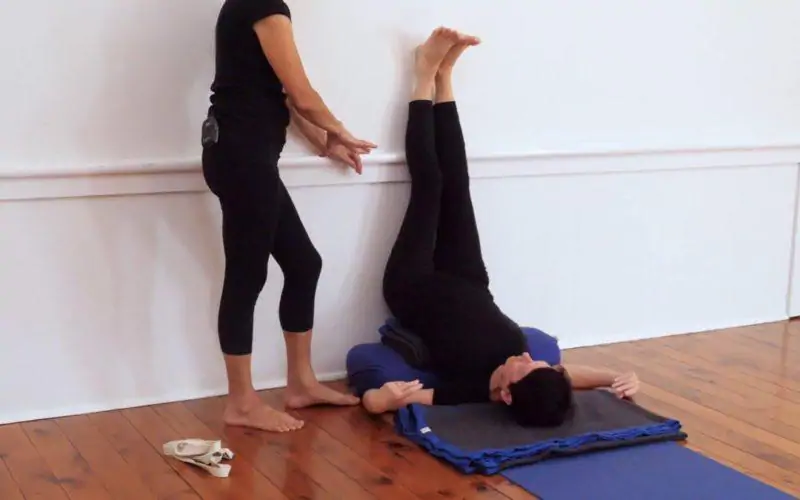
- Straighten your legs along the bolsters and press the soles of the feet into the wall. If your heels hang below the bolster, rest them on a block so they are level.
- Open your arms out to the sides, palms up, or bend them and rest the hands beside the head.
- Stay for five to ten minutes. Close your eyes and let the breath settle.
- To come out, bend your knees, slide further back towards your head until your back rests on the floor and your legs rest on the bolster. Stay there for a few breaths, then turn to one side and sit up slowly.
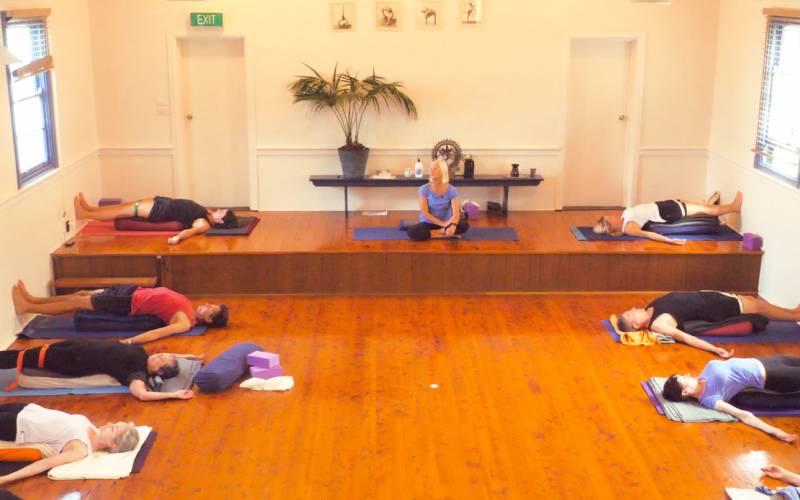
If you are short or the bolsters are firm, you may need to adjust the height of the blanket under the shoulders so the neck feels free. In restorative classes I spend time on this setup, because a few centimetres either way change the pose.
Key actions
Supported Setu Bandha Sarvangasana is a resting pose, but a few actions make it work.
- Shoulders – the outer shoulders drop to the floor and the shoulder blades move into the back. This lets the chest lift and broaden over the edge of the bolster.
- Chest – let the chest open from the back ribs, with the collarbones spreading. Breathe into the sides of the chest.
- Neck and throat – the back of the neck rests long, with the chin moving slightly away from the chest. The throat stays soft.
- Lower back – keep the buttocks moving towards the heels so the lower back stays long. If it pinches, the setup needs changing (see Cautions).
- Legs – press the feet lightly into the wall to keep the legs alive, while the abdomen and face stay soft.
Props and variations
- Two bolsters – the most common home setup. Two bolsters stacked, rather than end to end, give a higher lift for those who want more chest opening.
- Bench – Iyengar studios often use a padded bench made for this pose. The height is steadier than bolsters and the legs rest along its length.
- Legs apart – with the legs wider and resting on stacked bolsters, the pose becomes softer on the abdomen. I give this version on menstrual and low-energy days.
- Belt – around the thighs, it keeps the legs from rolling out so you do not have to hold them.
- Wall and blocks – the wall gives the feet something to press against. Blocks under the heels keep the legs level with the bolster.
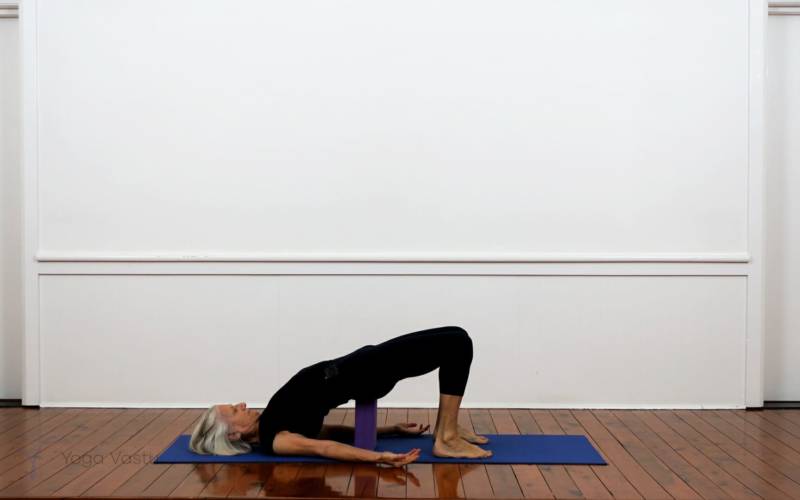
- Block under the sacrum – a shorter, simpler version. See Setu Bandha with Block.
- Unsupported bridge pose – lifting into the pose with the legs and back, with the hands supporting the back. See Setu Bandha Sarvangasana (bridge pose).
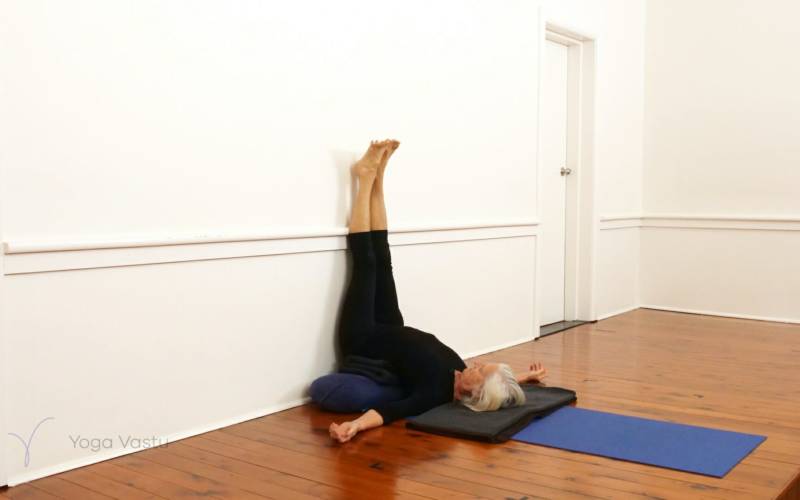
- Half setu bandha – I sometimes combine the pose with Viparita Karani, the legs-up-the-wall pose, in longer restorative sessions.
Cautions
Most students can practise this pose. Adjust it in these cases.
- Lower back – if the lower back aches, add the belt, raise the feet on blocks, or move the buttocks further towards the heels. If it still aches, bend the knees and rest the feet on the bolster.
- Neck – the shoulders, not the neck, should take the weight. If the neck feels compressed, add a blanket under the shoulders or come further onto the bolster.
- Headache or blood pressure – this pose is often used in Iyengar practice on days with a headache or as an alternative to inversions. If you have high blood pressure, a heart condition or an eye condition such as glaucoma, check with your doctor and teacher first.
- Pregnancy – lying back for long periods may not suit you in later pregnancy. Ask a teacher about a version with the head and chest raised higher.
- Recent injury or surgery – wait for clearance after back, shoulder or abdominal surgery.
Benefits
Supported Setu Bandha Sarvangasana opens the chest without effort, so breathing feels fuller and slower. The legs rest, the back is gently arched, and many students find the pose deeply relaxing after a long day or a demanding practice.
It is a substitute for Salamba Sarvangasana when inversions are not appropriate, during menstruation or when the neck or shoulders need a break. It also fits at the end of a restorative sequence, before Savasana. Students often say they feel calmer and less tired after five or ten minutes in it.
Common questions
What is the difference between bridge pose and supported bridge pose?
In bridge pose you lift the pelvis with the strength of the legs and back, or by walking the hands under the back. In supported bridge pose, bolsters or a bench hold the pelvis and legs up, so you can stay for several minutes without effort.
How do you do supported bridge pose with a block?
Lie on your back with your knees bent and feet near the buttocks, lift the hips and slide a block under the sacrum, the flat bone at the back of the pelvis. Lower onto it and straighten the legs if your back allows. This shorter version is described on our Setu Bandha with Block page.
Can you practise supported setu bandha during menstruation?
Yes. The Iyengar method uses supported Setu Bandha Sarvangasana as an alternative to inversions during menstruation. On those days I often give it on stacked bolsters with the legs apart.
What does setu bandha sarvangasana mean?
Setu means bridge, bandha means bond or formation, and sarvanga means the whole body. The name describes the body forming a bridge from the shoulders to the feet.
How long should you stay in supported bridge pose?
Five to ten minutes is usual. Come out sooner if the lower back or neck becomes uncomfortable.
About the teacher
Pixie Lillas: Pixie Lillas first went to the Ramamani Iyengar Memorial Yoga Institute in Pune, India in 1977. She co-founded the Balmain Iyengar Yoga Studio in 1980 and has been director and principal teacher there ever since.